
Hydro jetting vs snaking comes down to what you want out of the pipe. A snake (also called a cable or auger) punches a hole through a blockage so the line drains again. A hydro jetter uses high-pressure water to scour what is stuck to the pipe wall. Neither is the better tool in every case, and on some pipes one of them is the wrong tool.
If your drain is backing up right now, a cable is often the fastest way to get flow back. If the same line has blocked three times this year, a cable is probably why it keeps coming back. The rest of this guide explains how to tell which situation you are in.
What each method does inside the pipe
A drain snake is a steel cable with a cutting head, spun by a motor. The head bores into whatever is blocking the line and either breaks it apart, hooks it so it can be pulled back, or drills a channel through it. Water drains through that channel and the fixture works again.
What the cable does not do is clean the pipe. In a four-inch grease line the head might open a passage the width of a broom handle. The rest of the pipe wall stays coated, and that coating is what catches the next round of solids.
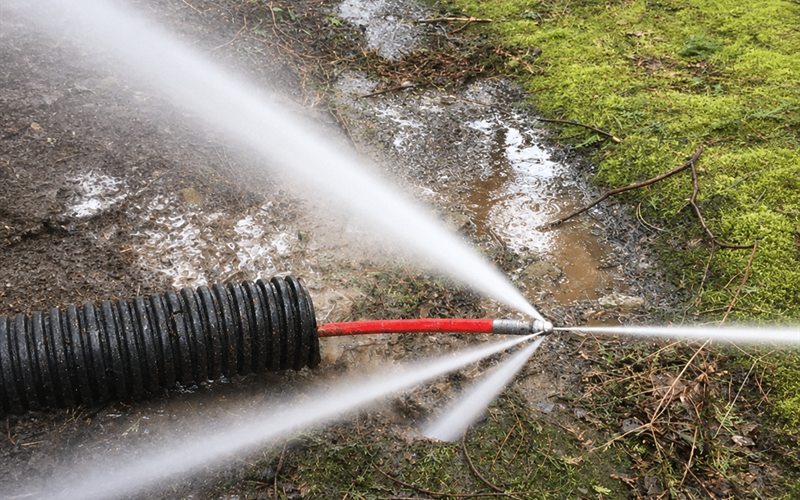
A hydro jetter pumps water through a hose to a nozzle with jets pointing backward and, on most nozzles, forward. The rear jets pull the hose up the line and blast the pipe wall as it goes. The debris is flushed downstream toward the main. Commercial units commonly run in the range of a few thousand psi, and the nozzle is chosen for the pipe size and for what is in the line.
Hydro jetting vs rodding is the same comparison under another name. “Rodding” is the term many municipal and industrial crews use for mechanical cleaning with rods or cable.
Hydro jetting vs snaking at a glance
| Snaking (cabling) | Hydro jetting | |
|---|---|---|
| What it does | Opens a passage through the blockage | Cleans the pipe wall and flushes debris out |
| Best at | A single obstruction: paper, a rag, a solid object | Grease, sludge, scale, soap and sediment along a length of pipe |
| Roots | Cuts them with a blade head | Cuts them with a root nozzle, and clears the fine hair roots too |
| Result lasts | Until buildup closes the passage again | Longer, because the buildup itself is gone |
| Risk on fragile pipe | Lower, though a cable can still catch on broken pipe | Higher if pressure and nozzle are not matched to the pipe |
| Access needed | Works through a fixture or a small cleanout | Usually needs a proper cleanout |
| Time on site | Often under an hour for one line | Longer, more so when the line is surveyed with a camera |
| Typical cost | Lower | Higher per visit |
The table is a starting point. The sections below cover the cases where it does not hold.
When a snake is the right call
A cable is a good tool for a one-off blockage in a pipe that is otherwise healthy. A toilet branch blocked by paper towels, a sink line with a foreign object in it, a floor drain choked with mop strings: these are obstructions, and removing the obstruction fixes the problem.
It is also the sensible first move when nobody yet knows what shape the pipe is in. A cable puts far less force on the pipe wall than a jetter. On a line that might be cracked or partly collapsed, getting some flow back gently and then putting a camera down it is a safer order of work than starting at full pressure.
Access matters as well. Plenty of older buildings have no usable cleanout on the affected branch. A small cable machine can work through a pulled trap or a roof vent. A jetter generally cannot.
When hydro jetting is the right call
Jetting earns its cost when the problem is buildup along the pipe, not one object in it. Three cases come up again and again in commercial buildings.
Grease lines. Grease is the largest single cause of sewer blockages. In its 2004 Report to Congress on sewer overflows, the U.S. Environmental Protection Agency attributed 47 percent of reported blockage events to grease and 22 percent to roots. In a restaurant, fats and oils cool and harden on the pipe wall downstream of the kitchen. A cable goes straight through soft grease and the hole closes behind it within weeks. Jetting with hot or cold water strips the layer off, which is why kitchens are usually put on a jetting schedule. Our guide on a restaurant floor drain backing up covers how to tell a grease problem from a local clog.
Scale in cast iron. Old cast iron rusts from the inside and the rust builds into hard, rough nodules. They narrow the pipe and snag everything that passes. A descaling nozzle or a chain cutter can take the pipe back toward its original bore. A standard cable head mostly rides over the scale.
Recurring blockages. If a line has been cabled twice in a year and has blocked again, the cable has been treating a symptom. That pattern is the clearest sign that the pipe needs cleaning, a camera inspection, or both.
Jetting is also the usual way to clean a line properly before it is lined or before a camera survey, because a camera cannot see the pipe wall through sludge.
When hydro jetting is the wrong tool
This is the part most comparisons leave out. High-pressure water is hard on pipe that is already failing.
When to stop and inspect first
Ask for a camera inspection before any jetting if one or more of these is true:
- The building is old enough to have clay, cast iron or Orangeburg (bituminous fiber) pipe, and nobody has surveyed it.
- The line has backed up with soil, gravel or pieces of pipe in the debris.
- There is a sinkhole, a wet patch or a dip in the paving along the pipe route.
- A previous contractor’s cable came back bent, or stopped hard at the same distance every time.
Jetting a cracked or separated pipe can wash away the soil that is supporting it, push water out into the ground, or turn a partial collapse into a full one. Orangeburg pipe in particular can be destroyed by pressure that sound cast iron would shrug off. A plumber who has seen the pipe on camera can lower the pressure, change the nozzle, or tell you the line needs repair and not cleaning.
Jetting also needs somewhere for the debris to go. If the line is completely blocked downstream, the water you pump in comes back out of the lowest fixture. In that case the usual sequence is to open the blockage with a cable first, then jet once the line can carry water.
Finally, jetting does not repair anything. It will cut roots out of a joint, but the joint is still open and the roots will be back. Our guide on tree roots in a commercial sewer line explains the difference between clearing roots and fixing the way they got in.
How a plumber decides between them
The decision is rarely made at the office. It is made after a few questions and, on anything bigger than a fixture clog, a look inside the pipe.
- What does the line carry? Kitchen waste points toward grease. Restroom waste points toward paper and wipes. A site main with trees nearby points toward roots.
- How many times has it blocked? A first blockage is treated as an obstruction. A third is treated as a pipe condition problem.
- What is the pipe made of, and how old is it? This sets how much force is safe.
- Is there a cleanout, and where? No cleanout limits the options and sometimes means installing one.
- What does the camera show? Once flow is restored, the camera settles the question: clean pipe, coated pipe, or damaged pipe.
On a typical recurring commercial blockage the visit goes cable, camera, then jetting if the camera shows buildup on sound pipe. If the camera shows a break, the conversation changes from cleaning to repair, and no amount of jetting would have fixed it.
What it means for downtime and cost
A cable visit is cheaper and shorter. For one blocked fixture in a sound pipe, paying for a jetter would be money spent on nothing.
Jetting costs more per visit because of the equipment, the water, the time and often the camera work that goes with it. Over a year it can still be the cheaper option on a line that blocks repeatedly, because one jetting visit can replace several emergency cable visits and the lost trading that comes with each one. We set out what moves the price in how much commercial hydro jetting costs.
Downtime is easier to plan with jetting. A scheduled jetting visit happens before opening or after closing. An emergency cable call happens whenever the line decides to block, and in a kitchen that is usually during service.
What not to do
Do not ask for jetting by name and expect it to be done blind. A contractor who agrees to jet an unsurveyed 60-year-old line without a camera is taking a risk with your pipe.
Do not treat chemical drain openers as a substitute for either method on a commercial line. They do little against a long grease coating, they are hazardous to the person who later opens that pipe, and many sewer agencies restrict what you may discharge.
Do not keep paying for the same cable job. If the invoice says “cleared main line” three times in twelve months, the useful next purchase is a camera inspection, not a fourth clearing.
Frequently asked questions
Is hydro jetting better than snaking? For buildup along the pipe wall, yes, because it removes the buildup. For a single obstruction in a healthy pipe, a snake does the job for less. For fragile or damaged pipe, a snake is the safer first step until the line has been inspected.
Can hydro jetting damage pipes? It can damage pipe that is already cracked, separated or badly corroded, and it can ruin Orangeburg pipe. Sound PVC, ABS and cast iron handle it when the pressure and nozzle are matched to the pipe. That is the reason for inspecting old lines with a camera first.
How long does hydro jetting last compared with snaking? There is no fixed figure, because it depends on what goes down the drain. A cabled grease line can block again within weeks. A jetted one typically goes months, and a kitchen on a jetting schedule should not reach the point of blocking at all.
Do I need a camera inspection before hydro jetting? Not for every job. For an older building, an unknown pipe material, or a line with a history of blockages, it is the sensible order of work. It shows whether the pipe can take the pressure and whether cleaning will solve the problem.
Can a snake remove tree roots? A cable with a blade head cuts through the main root mass and restores flow. It tends to leave the fine roots and it does nothing about the opening they came through, so regrowth is expected. Jetting clears more of the root material, and a repair is what stops it returning.
Clean it or clear it
The question to ask about your drain is not which machine is better. It is whether the line has an object in it or a coating on it. An object wants a cable.
A coating wants a jetter. A pipe you know nothing about wants a camera before either.
If you have a line that keeps blocking and you want to know which of those it is, our crews carry cable machines, jetters and cameras on the same truck. See commercial drain and sewer services, or call (866) 981-1310 and tell us how many times the line has blocked and what it carries.